Parachutist Badge, Combat Jump Stars and Background Trimming
Parachutist Badge
Captain William P. Yarborough, 501st Parachute Battalion designed the parachutist badge. He explored many concepts but settled on one. His design had the wings out spread with the feather tips turned up. This was rejected by the War Department as being too similar to the pilots wings. He then sketched a design in which the wing tips curved up to touch the canopy to create the parachutist badge we know today. On 22 April 1941, Capt. Yarborough wrote a memorandum for record documenting the history of the development of the parachutist badge.
"On March 3, 1941, I was ordered to Washington to report to the Adjutant General for temporary duty in the Office of the Chief of Infantry. My mission was the procurement of a suitable parachutist badge with would meet with the approval both of the War Department and the Commanding Officer of the 501st Parachute Battalion. Major Miley (commander of the 501st), before my departure, gave me full authority to approve any design that I considered acceptable, and to do so in his name. The same authority was delegated to me in the name of the Chief of Infantry."
"I drew the original sketch in the office of Lieutenant Colonel Beuchner, G-3; a finished copy of my original sketch was prepared in the office of the Quartermaster General."
"I personally took the correspondence relative to the badge's approval from one office to another until the transaction was complete. This operation took me one entire week, eight hours a day."
Note: 06 March 1941 - Bailey, Banks and Biddle (BB&B) was advised by the Army that they would produce the parachutist badge.
07 March 1941 - Order for the badges was submitted by the Office of the Quartermaster General (OQMG) to Bailey, Banks and Biddle.
12 March 1941 - Bailey, Banks and Biddle submits lead strikes to OQMG for approval.
13 March 1941 - OQMG notifies the 501st PB that 350 badges would be shipped with expected arrival date of 15 March 1941. Guidance was provided that the 501st PB would provide a copy of published order awarding the parachutist badge with names and Army Service Numbers to OQMG.
"Through the help of Mr. A.E. Dubois, in the Quartermaster General's office, 350 of the badges were procured from the Bailey, Banks and Biddle Company in Philadelphia and were in the hands of the Commanding Officer of the 501st Parachute Battalion by March 14, 1941. This is believed to have been an all time speed record for War Department Procurement."
11 March 1941 - Orders were published listing the Officers and men who had successfully completed six parachute jumps and were qualified as parachutist.
21 March 1941 - The 501st PB had a ceremony in which Major Miley pinned the first parachutist badges at Fort Benning, GA.

The parachutist badge in this photo was presented to 1st Lt. James Bassett who first served as the Assistant Platoon Leader for the Test Platoon. The parachutist badge is from the first order of 350 badges made by Bailey, Banks & Biddle. Additionally, they are displayed on a 501st Parachute Battalion (later 501st PIR) background trimming made of red felt and light blue stiched border. It is not certain when this background trimming was made, it is believed to be the first commercial example. The original background trimming for the 501st Parachute Battalion was designed by Capt. Yarborough and a two piece wool felt of red superimposed on a larger blue oval was made by his wife. (Courtesy: Johnston Collection)

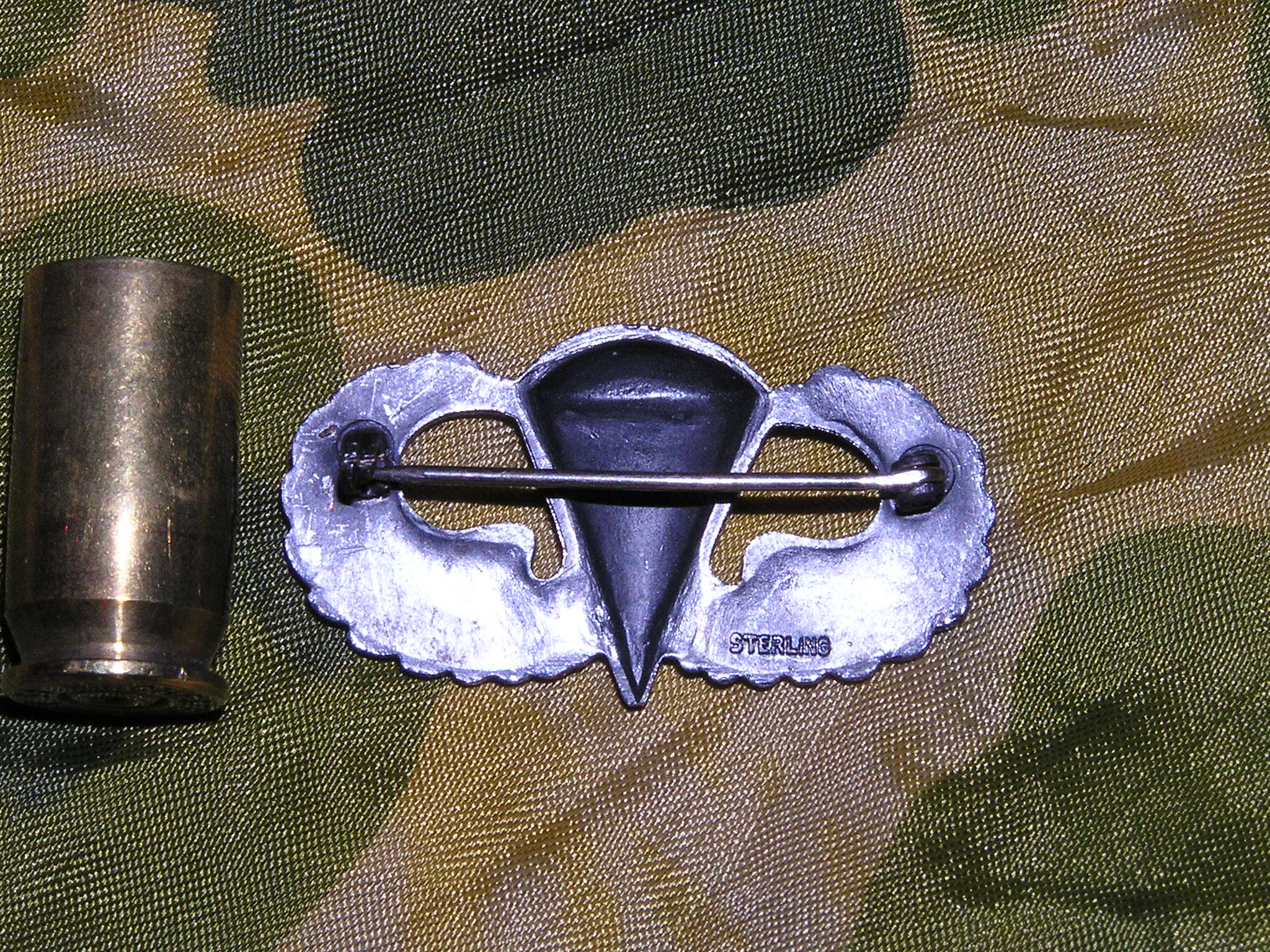
The photo shows the reverse side of 1st Lt. James Bassetts parachutist badge with the BB&B STERLING mark distinctive of the first issued badges (Courtesy: Johnston Collection)
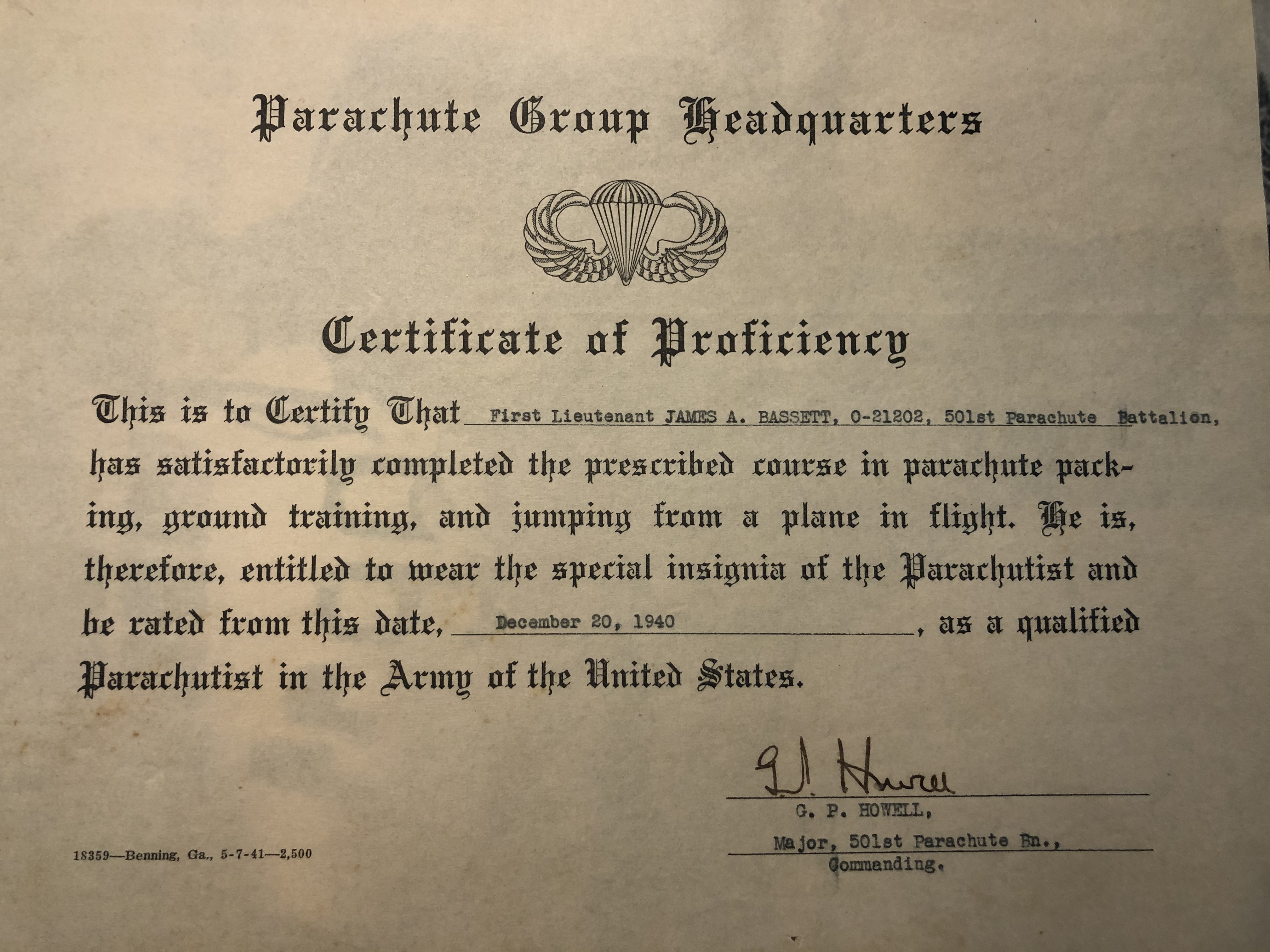
1st Lt. James Bassetts Parachute Qualification Certificate. Note that this certificate was first produced in May 1941 after the badge was authorized. Administrative Clerks then went back and typed up certificates for all previously qualified personnel such as members of the test platoon. 1st Lt. Bassett completed his qualifiying jumps which was six at the time on 20 December 1940. (Courtesy: Johnston Collection)
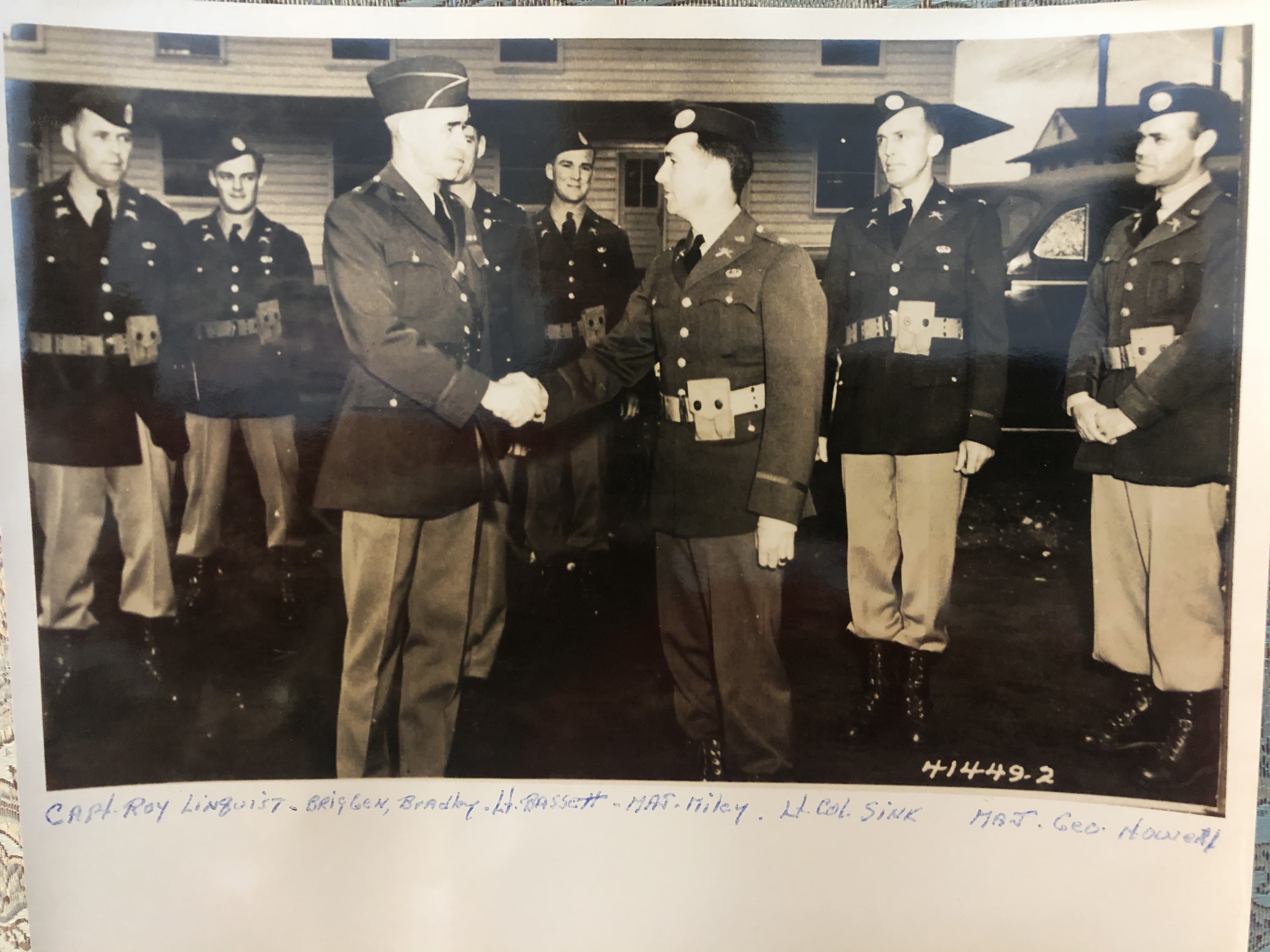
Photo from the ceremony of 21 March 1941 in which Major Miley commander of the 501st Parachute Battalion presents the first parachutist badges in a ceremony. Brigadier General Omar Bradley is shaking hands with Major Miley. In the back between them is 1st Lt. Bassett. Other officers in the photo are Capt. Linquist, Lt Col. Sink and Major Howell (Courtesy: Johnston Collection)
23 April 1941 - 400 additional badges are requested by the 501st PB from OQMG.
Captain Yarborough applied for a patent to protect the design from unauthorized reproduction. On February 2, 1943, Patent #134963 was granted for "A Parachutist's Badge" for a period of three and one-half years.

Captain Yarborough described his own concept of requirements for earning and retaining the parachutist badge. They were as follows, "This device is authorized for all rated parachutist, i.e., all who have performed the basic jumps as outlined in my article 'Aerial Adventure'. Any member of the 501st who at any time refuses to perform a parachute jump, loses his right to wear the badge. Upon seperating from active jumping status through transfer, a parachutist remains so rated for one year, at the end of which he no longer has the right to wear the badge."
Symbolism: The wings suggest flight and, together with the open parachute, symbolize individual proficiency and parachute qualifications.
Description: An oxidized silver badge 1 13/64 inches (3.06 cm) in height and 1 1/2 inches (3.81 cm) in width, consisting of an open parachute on and over a pair of stylized wings displayed and curving inward. A star and wreath are added above the parachute canopy to indicate the degree of qualification. A star above the canopy indicates a Senior Parachutist; the star surrounded by a laurel wreath indicates a Master Parachutist.
Niether the Senior or Master Parachutist designs were in use during WWII. They were authorized by Headquarters, Department of the Army in 1949 and were announced by Change 4, Army Regulation 600-70, dated 24 January 1950.

Worn by 1st Lt. Mike O'Brien, 509th PIB. Although these are World War II era wings these are not his graduation wings. Mike O'Brien was an original 504th Parachute Battalion member and would have been awarded a BB&B made Parachutist Badge.

Worn by Ed Solak, 509th PIB. These wings are of a very thin construction when compared to other WWII manufactured wings. (Photo courtesy of Mark Bando)
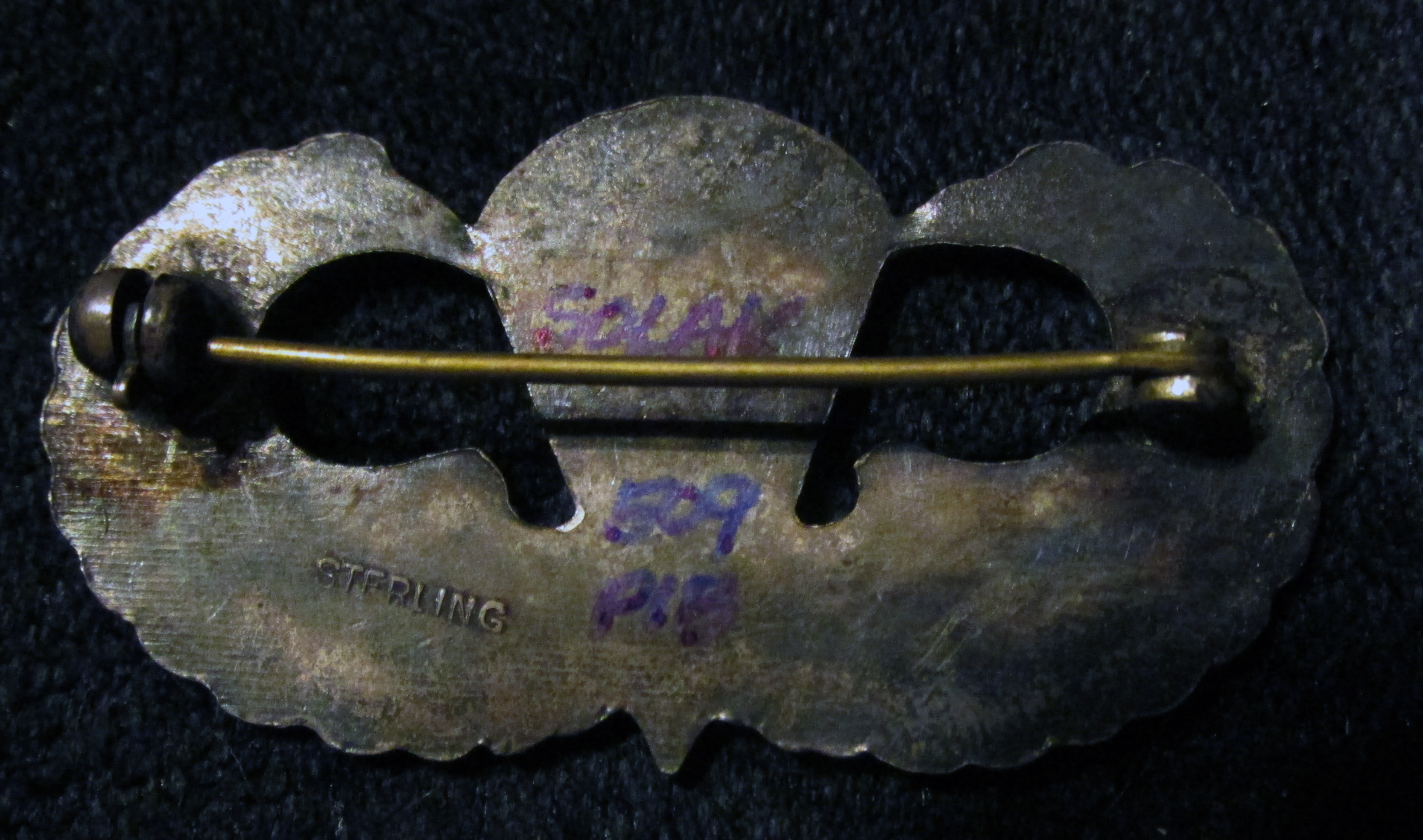
Reverse of wings worn by Ed Solak, 509th PIB. (Photo courtesy of Mark Bando)
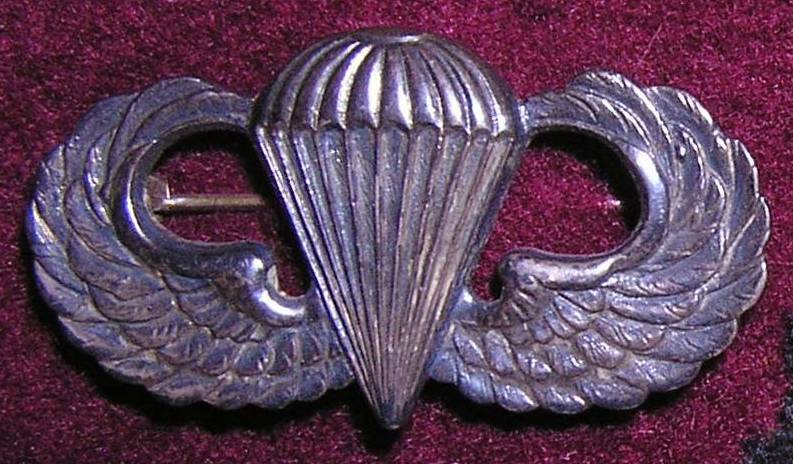
Wing found on original 509th PIB beret is of Durocharm manufacture
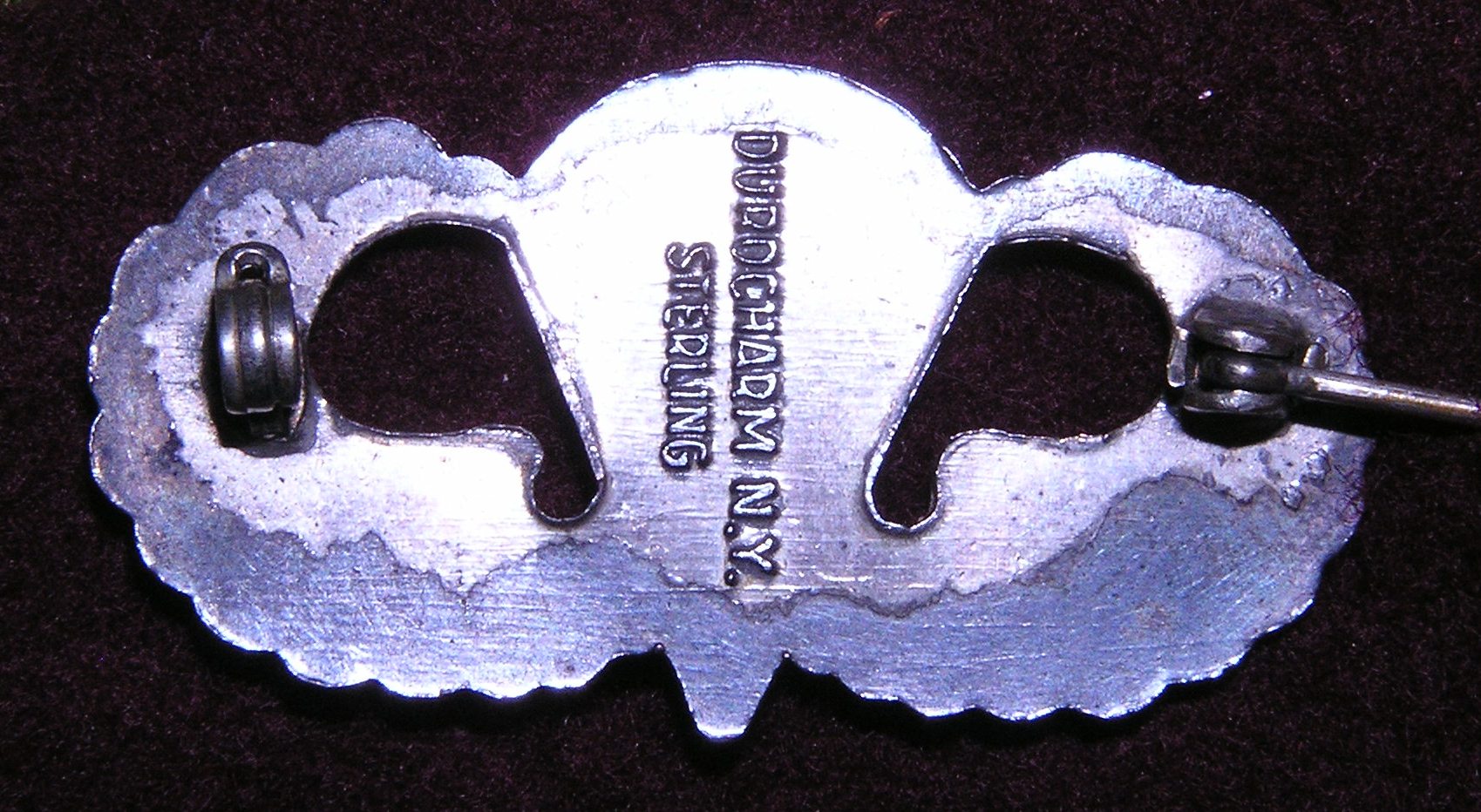
Reverse of wing found on original 509th PIB beret
Combat Jump Stars
Even before the first American combat jump had been executed, paratroopers were considering ways in which to distinguish paratroopers who had made combat jumps from those who have not. On 25 October 1942, the night before the (2/503rd PIR (509th) would head to the airfields in southern England, Battalion Commander Lt. Col. Edson Raff addressed the Officers and men. He announced that the jump would be into North Africa and concluded "We're going to have a difficult job because some people down there will want to fight us and some won't. If they welcome us - and some authorities say they will - we won't fire a round. If they don't - you have your orders! One last thing, those who participate in the first jumps in North Africa may be able to wear a gold-tipped parachute insigne some day. I'm going to try to sell the idea to the War Department. It's the best way I know for Uncle Sam to recognize the first American Paratroopers going into action for our country!"
It is not known if Lt. Col. Raff ever followed up with his proposal but even if he had it is likely that the War Department would have rejected the idea. Before the 82nd Airborne showed up in North Africa in 1943 most of the troopers in the 2/509th PIR already had one and some had two combat jumps. To distinguish themselves 509th troopers began to place small stars around their parachutist badge. The stars came from a variety of sources based on what was available. In many cases they used the silver stars off the uniforms of captured Italian Soldiers. Since there were no regulations governing this practice some troopers used the stars and arrowhead to represent invasion participation be it airborne or amphibious in the same manner as the campaign ribbon.
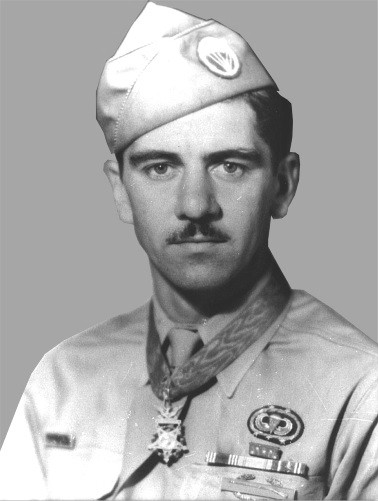
Paul Huff, 509th PIB wears 5 stars around his parachutist badge. Three stars are for combat jumps and two stars are for amphibious landings.
Lt. Col. Yarborough attempted to develop and standardize this idea by exploring several concepts for affixing spearheads or stars directly to the wings to represent combat jumps and even stars and wreaths to depict total number of jumps. No further designs were approved during WWII, however 509th troopers in Italy gradually began attaching the stars directly to the parachutist badge.
Stars representing participation in combat jumps had been worn unofficially on parachute wings during and after World War II. This practice did not gain official sanction until after the 1983 invasion of Grenada, Operation Urgent Fury. The addition of stars to the basic, senior and master parachute wings for each combat jump were approved by Headquarters, Department of the Army on December 14, 1983.
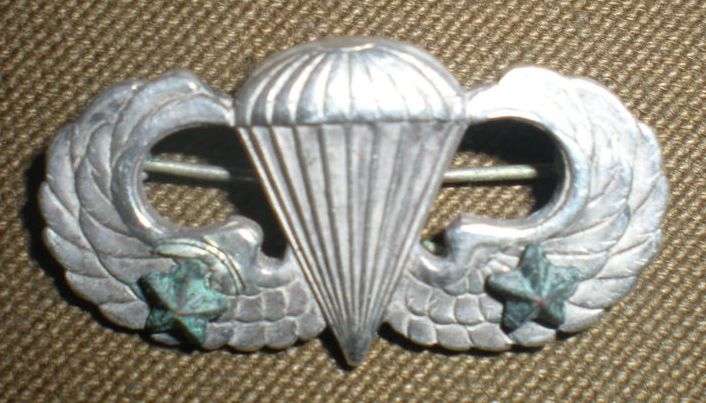
Two combat jump stars on wings attributed to a 509th Veteran

Three combat jump stars on wings belonging to Pfc. John H. Allen, C/505th PIR
References:
The Institute of Heraldry
U.S. Army Quartermaster Foundation
We Jumped to Fight by Edson Raff
Original Source Documents
Oral History Interviews